Claude subscription or AI agents via the API: how business leaders should bring AI into their company
Give every employee a subscription, or deploy agents that work on your own server and are billed by usage? Two business models, two uses, and a simple method to choose, backed by official figures.
Kais KhenineDigital strategy and AI consultant and trainer, i2Business
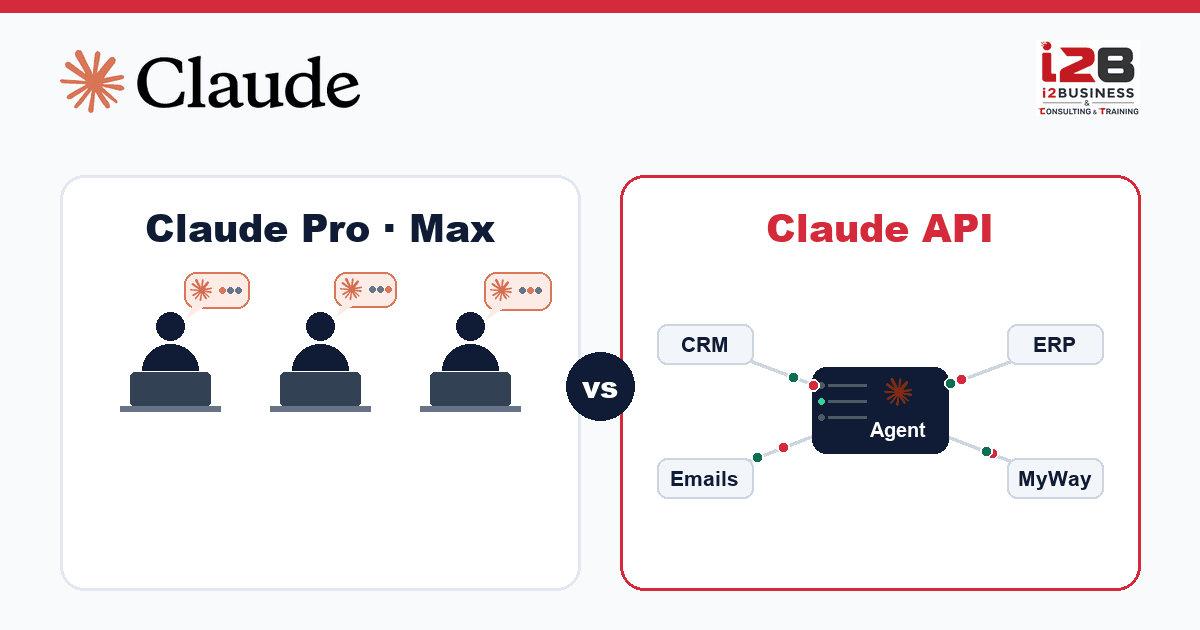
In most companies, the question is no longer “should we use AI?” but “how do we pay for it, and what for?”. Behind that choice lie two very different approaches: equipping each employee with a subscription, or deploying agents that work directly inside your information system and are billed by usage.
This guide is written for CEOs, CFOs, HR directors and CIOs. It compares both approaches using the official pricing of Anthropic, the company behind Claude, as checked on November 25, 2026 [1, 2, 3].
1. One seat per person: the per-employee subscription
This is the best-known entry point. Each person has their own access to Claude, on the web, desktop or phone, and uses it to draft, analyze a document, prepare a meeting or summarize a file.
Pro: $20 per month billed monthly, $17 per month billed annually [3].
Max: $100 per month, for heavy use (5 times Pro usage) [3].
Team: from $25 per seat per month billed monthly, for 2 to 150 seats, with central billing and SSO [3].
Enterprise: a price per seat, plus usage billed at API rates [3].
What you buy: time saved by each employee. What you pay: a fixed cost that grows with headcount, whether or not the tool is used.
A subscription is an excellent personal accelerator. But it remains a tool that each person must open, prompt and review: it does not act on its own inside your software.
2. Via the API, on your server: agents that work on their own
An agent is not a chatbot. It is a model that decides which actions to take (look up a customer in the CRM, read an invoice, draft a follow-up), checks the result, then carries on until the task is done. It is connected to your tools and works without waiting to be asked.
Anthropic offers three ways to build one:
The Claude API with your own tools: you describe the possible actions and the agent chooses which ones to use. Full control, ideal for connecting to an existing CRM or ERP.
The Claude Agent SDK: the engine behind Claude Code as a library, with file reading and writing, a terminal and web search built in [4].
Claude Managed Agents: Anthropic hosts the agent loop and an isolated workspace for each session, billed at $0.08 per hour of runtime on top of tokens [1, 5].
What you buy: completed tasks. What you pay: a variable cost, per token used. No activity, no bill [1].
What does an agent really cost?
Anthropic publishes a worked example: a one-hour agent session on Claude Opus 5.5 that reads 50,000 tokens and writes 15,000 costs $0.58, including $0.08 of runtime. With prompt caching, it drops to $0.43 [1].
For a business leader, the order of magnitude speaks for itself. With the same workload as this example, an agent active two hours per working day, about 44 hours a month, would cost around $25 a month. This is only an assumption: the real cost depends on how much text the agent reads and writes, to be measured on your own tasks.
The two models do not deliver the same service: a subscription helps one person, an agent runs a process. The comparison mainly shows the cost logic: fixed per head on one side, proportional to the work actually done on the other.
Which Claude model should power your agents?
All four current models read up to 1 million tokens of context, roughly 555,000 words [2]. They differ in capability, speed and price, given per million input and output tokens [1, 2]:
Claude Fable 5.2 ($8 / $40): the most capable, for demanding reasoning and long, autonomous tasks.
Claude Opus 5.5 ($4 / $20): Anthropic's recommended starting point, for agents that work over long periods.
Claude Sonnet 5.5 ($2 / $10): the best balance of speed and intelligence, for everyday production work.
Claude Haiku 5.5 ($0.10 / $0.50, for requests up to 100,000 tokens): the fastest, for high volumes such as sorting, extraction or routing.
In practice, the right architecture often mixes models: a powerful model plans and decides, a lighter model handles the repetitive sub-tasks.
Three levers to keep the bill under control
Prompt caching: re-reading context already sent (instructions, catalog, procedures) costs 95% less on Opus 5.5 and Sonnet 5.5 [1].
Batch processing: 50% off anything that is not urgent, such as overnight analyses or weekly reports [1].
The right model for the right task: Haiku to sort, Sonnet to produce, Opus or Fable to decide.
Concrete use cases for businesses
Sales: qualify the leads received each morning (LinkedIn, forms, trade shows) and prepare follow-ups in the CRM.
Finance: read supplier invoices, extract the amounts and enter them in the ERP.
Customer service: answer recurring questions from your knowledge base, and hand over to a human when needed.
Training and HR: analyze satisfaction surveys and produce a summary for each session.
Monitoring: watch calls for tenders and summarize those that match your business.
Operations: prepare the production manager's morning brief from the previous day's data.
How to decide: a four-question method
Is the task repetitive and well defined? If so, it is a candidate for an agent. If it requires case-by-case judgment, a subscription is often enough.
Is the data in your tools? An agent delivers its full value only if it can read and write in your CRM, ERP or email.
Can a mistake be caught? Start with tasks where a human approves before anything is sent, then expand.
Is the gain measurable? Measure the time spent on the task today: that is your baseline for judging the agent.
In most organizations, the winning strategy is not one or the other: subscriptions for the teams that create, agents for the repetitive processes. A subscription helps each person; an agent works for the whole company.

 Kais KhenineDigital strategy and AI consultant and trainer, i2Business