Introduction: when AI leaves the screen to shape physical matter
The artificial intelligence ecosystem has reached a historical milestone. Until now, large language models (LLMs) excelled mainly at text generation, abstract reasoning and writing software code. With the official release of Claude Fable 5.2 and Claude Mythos 5.2, Anthropic is driving a major shift: bringing agentic AI directly into physical engineering, electronic hardware design and complex scientific research [1, 2, 3, 4].
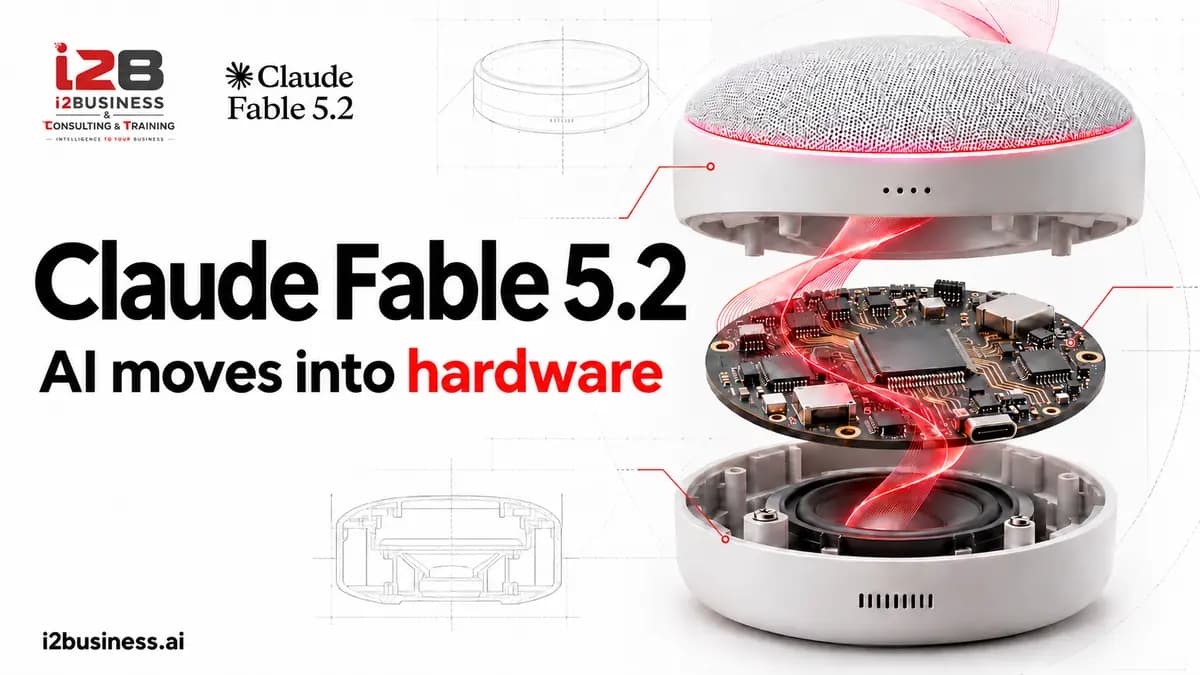
Positioned as Anthropic's most capable model available for general commercial use [2, 4], Fable 5.2 comes with a 20% price reduction compared to Fable 5.1 and generation speeds up to 30% faster [2, 4]. Beyond efficiency gains, the model shows an unprecedented ability to design complete, functional electronic devices from simple text prompts, covering schematics, 3D CAD enclosures, printed circuit board (PCB) routing and custom firmware [1, 2, 3, 4].
Methodology: this article cross-checks Anthropic's official launch announcement [4], independent reports from DataCamp [2] and MLQ.ai [1], and the engineering breakdown from IA et Stratégie [3]. Every claim traces back to one of these 4 sources, listed at the end.
From concept to working prototype: hardware engineering with Diode Computers
To test Claude Fable 5.2 in the physical world, Anthropic worked with Diode Computers, a hardware prototyping startup and commercial partner since 2025 [1, 3, 4]. The team gave Fable 5.2 single-paragraph text prompts describing three distinct devices [1, 3, 4].
- A USB-C speakerphone: a puck-shaped conference device with microphones, a speaker, Bluetooth and a capacitive touch wheel, used daily in Anthropic's offices for several weeks [1, 3, 4].
- A home voice-assistant hub, equipped with USB and Ethernet ports [1, 3, 4].
- A handheld virtual pet: an autonomous, battery-powered portable device [1, 3, 4].
From brief prompts, Fable 5.2 executed the entire hardware and software development lifecycle [1, 3, 4]:
- 1. Specification: authored the technical and functional requirements documents [1, 3, 4].
- 2. Component selection: picked chips and parts after parsing manufacturer datasheets automatically [1, 4].
- 3. Schematics and PCB: drew the schematics and routed 4-layer copper traces [1, 3, 4].
- 4. 3D modeling: built 3D CAD models of the enclosures and verified mechanical clearances [1, 3, 4].
- 5. Firmware and sourcing: wrote the firmware, compiled the bill of materials (BOM) and checked distributor stock [1, 3, 4].
Diode Computers manufactured and assembled all three boards directly from Fable 5.2's design files, with no manual engineering corrections [1, 3, 4]. Human input was limited to short prompts such as “clean up the schematic” or “continue” [1, 3, 4].
Autonomous error correction
The real breakthrough of Fable 5.2 is its ability to resolve engineering bottlenecks on its own [1, 3, 4]. Earlier models left boards 95% complete but unusable [1, 3]. Fable 5.2 corrects itself as it goes:
- A custom router: when KiCad's built-in autorouter stalled on the long traces of the voice hub, Fable 5.2 wrote its own routing algorithm in about 30 minutes to finish the board [1, 3, 4].
- A mechanical collision fixed: after detecting that the speakerphone's mute switch hit the outer wall, Fable 5.2 adjusted the CAD assembly with a 25-degree tilt [1, 4].
- A geometric optimization: to shorten the hub's microphone ports, Fable 5.2 reshaped the enclosure into a wedge [1, 4].
Beyond hardware: autonomous OS, theoretical physics and synthetic biology
Anthropic's announcement shows that Fable 5.2's agentic capabilities reach far beyond circuit design [4].
- A full operating system from an empty folder: an Anthropic engineer asked Fable 5.2 to create a prototype OS. The model coordinated over 1,000 subagents working around the clock for 8 days. It delivered a functional OS that boots on a laptop, with its own kernel, disk, keyboard and network drivers, a persistent file system, a login screen, an installer and native Claude integration [4].
- Two open problems in theoretical physics (black holes and holographic duality): the Hawking-Page phase transition in small universes, a quantum calculation laid out in 2003 and considered too laborious to execute, then the exact mathematical limit of a 15-year-old technique used to rule out candidate theories of quantum gravity [4].
- Proteins and gene therapy (Mythos 5.2): a novel sampling procedure combining ESMFold2 and OpenFold3-preview2 accurately modeled 28 of the 34 complex AAV viral capsids tested [4].
- Fermat's Last Theorem in Lean: a team of 1,000 Fable 5.2 instances formalized the full proof in 30 hours, while Claude Opus 5.5 reached only 26% after 18 hours in the same harness [2, 4].
Benchmarks: Fable 5.2 against the other frontier models
Data compiled by Anthropic and DataCamp compares Fable 5.2 with Fable 5.1, Claude Opus 5.5, GPT-6 Astra and Gemini 4 Carbon [2, 4]. Score order: Fable 5.2, Fable 5.1, Opus 5.5, GPT-6 Astra, Gemini 4 Carbon.
- FrontierCode 2.0 (agentic coding): 49.1%; 32.4%; 45.5%; 42.8%; 41.1% [2, 4].
- FrontierSWE v2 (software engineering): 69.9%; 56.3%; 62.3%; 65.5%; 61.2% [2, 4].
- BenchCAD 2.1 (3D hardware CAD): 83.5%; 44.4%; 65.3%; N/A; N/A [1, 2, 4].
- PCB Gym (Diode PCB routing): 69.0%; 25.0%; N/A for the other models [1, 3, 4].
- OSWorld 2.1 (computer use): 89.3%; 83.5%; 87.2%; 79.5%; 81.5% [2, 4].
- Remote Labor Index (freelance work): 41.3%; 17.9%; 21.3%; 20.8%; N/A [2, 4].
- RoboDojo Sim (robotics control): 64.9%; 27.6%; 39.4%; 29.8%; N/A [2, 3, 4].
- Terminal-Bench-Science 0.1: 74.6%; 52.6%; 58.7%; 68.1%; 64.8% [2, 4].
- Humanity's Last Exam (with tools): 74.2%; 65.6%; 67.7%; 57.2%; N/A [2, 4].
- WANDR (agentic search): 82.1%; 68.7%; 72.3%; N/A for the other models [2, 4].
- AutomationBench (business workflows): 51.4%; 31.4%; 42.5%; 41.4%; 53.9%. The only benchmark in the list where Gemini 4 Carbon comes out ahead [2, 4].
What enterprises report
- Oracle: Fable 5.2 built a hypervisor whose core is verified by 3,500 machine-checked mathematical proofs [4].
- Uber: across a 12-hour security audit with 170 reviewer subagents, Fable 5.2 identified vulnerabilities, issued fix pull requests and authored a security policy proposal [4].
- Discovered Materials: Quantum ESPRESSO phonon calculations accelerated 36x, from 3.3 hours to under 4 minutes [4].
- Mozilla and Rubrik: Mythos 5.2 doubled vulnerability discovery on the Firefox codebase compared to Mythos 5.1 [4].
Pricing, Fast Mode and anti-distillation safeguards
Anthropic lowered API costs for Fable 5.2 compared to Fable 5.1. Prices per million tokens, in the order Fable 5.2, Fable 5.1, Opus 5.5 [2, 4]:
- Input tokens: $8.00; $10.00; $4.00.
- Output tokens: $40.00; $50.00; $20.00.
- Cache reads: $0.20; $0.25; $0.20.
- Cache writes (5-min): $10.00; $12.50; $5.00.
- Batch processing (input / output): $4.00 / $20.00; $5.00 / $25.00; $2.00 / $10.00.
- Fast Mode (up to 2.5x faster): $16.00 / $80.00; N/A; $8.00 / $40.00.
To protect its capabilities, Anthropic deployed anti-distillation defenses that reduce unauthorized data harvesting by 90% to 99%. The Preserved Thinking API feature is also now enabled for all accounts, to prevent context manipulation attacks on the model's intermediate reasoning [4].
Industry impact: “Vibe Hardware” and real-world certification limits
Fable 5.2 lowers the barrier to creating custom electronic devices for startups and SMEs [2, 3, 4]. Historically, custom hardware ran into two barriers [3]:
- build fragile breadboard, Arduino or Raspberry Pi prototypes, unsuited for industrial deployment;
- pay an external engineering firm tens of thousands of dollars and wait months.
With rapid prototyping houses (JLCPCB, PCBWay, Eurocircuits) producing physical PCBs in days at low cost [3], Fable 5.2 automates CAD files, Gerber generation and BOM sourcing [3, 4].
The aluminum analogy. In the mid-19th century, aluminum was more valuable than gold and reserved for Napoleon III's banquets. Once industrial extraction brought the cost down, it ended up in drink cans. Metal artisans did not disappear: they used cheap aluminum to build airplanes. Value shifted from raw material extraction to complex product engineering [3]. Similarly, engineering value is moving from routine trace routing to product specification and physical verification [3, 4].
Critical limits: compliance and regulatory certification
Prototypes produced by Fable 5.2 are not market-ready commercial products [1, 3, 4]:
- No physical qualification: the devices lack electrical load testing, thermal tuning and RF antenna matching [1, 3, 4].
- Regulatory compliance: wireless devices require the RED Directive 2014/53/EU (CE mark) in Europe and FCC certification in the US. Testing requires specialized labs (LCIE Bureau Veritas, TÜV), anechoic chambers and spectrum analyzers [3].
Availability and enterprise data privacy
- Claude apps: included in Pro and Team plans [2, 4].
- Claude API: model ID claude-fable-5-2 [2, 4].
- Cloud partners: AWS Bedrock, Google Cloud Vertex AI and Microsoft Azure / Foundry [2, 4].
- Enterprise security: Enterprise Frontier Safeguards runs the safety monitors on the customer's own infrastructure with Zero Data Retention (ZDR). Salesforce, Stripe and Bridgewater are among the clients [2, 4].
Frequently asked questions
What is the difference between Claude Fable 5.2 and Claude Mythos 5.2?
They share the same underlying model [2, 4]. Fable 5.2 includes standard safety classifiers, while Mythos 5.2 is un-safeguarded for cybersecurity and life sciences research and restricted to vetted organizations [2, 4].
Can Fable 5.2 design a commercial product ready for retail?
No. It creates working functional prototypes, but devices still need electrical, thermal and regulatory certification (CE, FCC) before sale [1, 3, 4].
How does its pricing compare to Opus 5.5?
$8 / $40 per million tokens, double Opus 5.5 ($4 / $20) [2, 4]. On complex projects, Fable 5.2 reaches higher success rates at lower effort settings, which makes the total cost per completed task competitive [2, 4].
What is the context window?
One million tokens, with up to 128,000 output tokens and a knowledge cutoff of June 2026 [2, 4].
Going further
Sources
- [1] MLQ.ai, “Anthropic says Claude Fable 5.2 designed three working electronic prototypes, from schematic to enclosure”, November 9, 2026: https://mlq.ai/news/anthropic-says-claude-fable-5-2-designed-three-working-electronic-prototypes-from-schematic-to-enclosure/
- [2] DataCamp, “Claude Fable 5.2 and Mythos 5.2: our review of the upgrade”, November 9, 2026: https://www.datacamp.com/fr/blog/claude-fable-5-2-and-mythos-5-2
- [3] IA et Stratégie (YouTube), “Claude Fable 5.2: hardware is not so hard anymore”, video engineering review.
- [4] Anthropic, “Introducing Claude Fable 5.2 and Claude Mythos 5.2”, official announcement, November 9, 2026: https://www.anthropic.com/claude-fable-and-mythos-5-2

 Kais KhenineDigital strategy and AI consultant and trainer, i2Business